Outdoor Lighting Ideas for Office Buildings
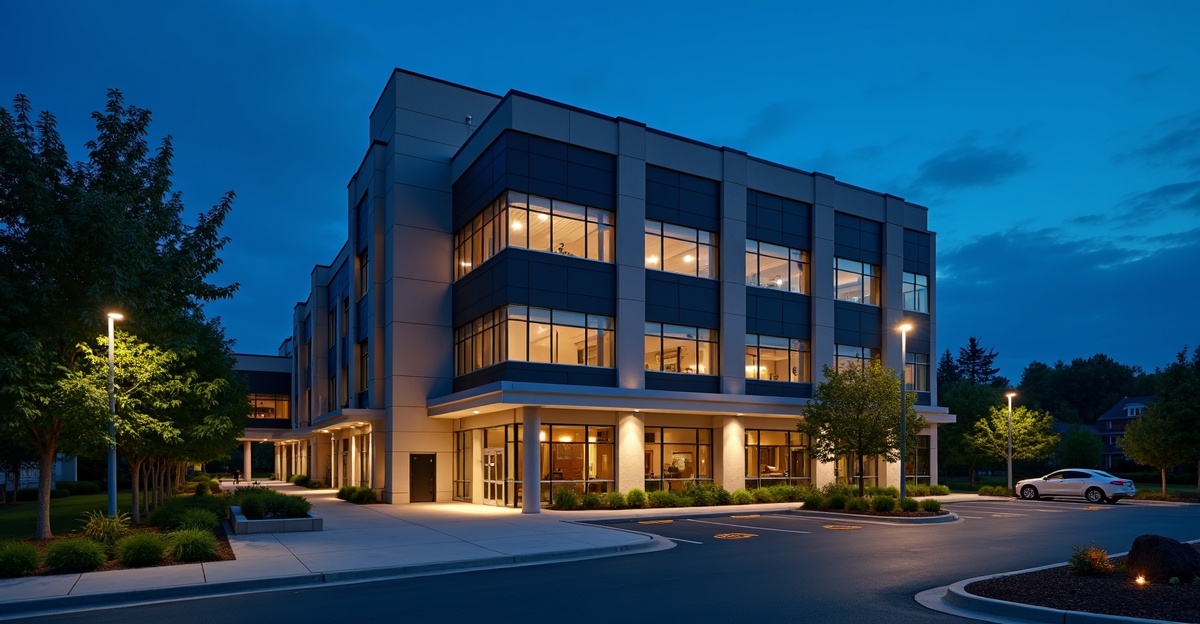
Outdoor Lighting Ideas for Office Buildings focus on using office exterior lighting to improve safety, reduce liability, and reinforce a professional nighttime presence across facades, entries, and parking areas. We take a strategic approach that balances illumination levels, uniformity, energy efficiency, and smart controls to support compliance, strengthen security, and improve long-term operational performance.
Key Takeaways
- We prioritise high-impact zones such as facades, entryways, pathways, parking lots, and signage to improve safety, visibility, and brand presence.
- We design for uniform illumination, glare control, and dark-sky compliance to reduce liability and improve visual comfort.
- We use LED fixtures, photocells, motion sensors, and zoning controls to cut energy use and lower maintenance costs.
- We implement smart lighting systems for scheduling, remote monitoring, performance tracking, and scalable upgrades.
- We start projects with a lighting audit and prioritise safety-critical areas to maximise ROI and strengthen long-term property value.
Safer, Brighter First Impressions: Why Office Exterior Lighting Matters Most
Office exterior lighting is a functional asset, not just a decorative feature. It supports safety, reduces liability, strengthens security, and sharpens office curb appeal at the same time.
Commercial building lighting differs significantly from residential systems. We must account for larger footprints, higher illumination levels, structured parking areas, and stricter durability standards. Liability exposure also increases in commercial environments. A poorly lit walkway in front of an office building carries far more risk than a dim backyard path.
Safety drives every decision. Properly illuminated walkways, entries, ramps, and parking areas help reduce trip-and-fall incidents. Consistent light levels also deter vandalism and trespassing by removing dark hiding spots. For businesses evaluating outdoor security lighting, exterior lighting plays a central role in discouraging unwanted activity before it starts.
Compliance also matters. Local codes often establish minimum illumination levels for parking lots and building entrances. Dark-sky principles aim to reduce light pollution through downward-directed fixtures and glare control. We design with these requirements in mind without overcomplicating the process.
A few practical benchmarks guide planning:
- Parking areas generally require higher and more uniform illumination than landscaped zones.
- Entrances should appear brighter than surrounding areas to create a safe visual transition and support visibility.
Property owners planning new builds or retrofits need balanced guidance. We combine safety, appearance, energy efficiency, and automation strategies into one cohesive commercial building lighting plan. Done correctly, exterior lighting improves daily operations while strengthening brand perception after sunset.
High-Impact Lighting Zones Every Office Building Should Prioritise
Facade Lighting That Reinforces Professional Presence
Facade lighting defines how the building appears at night. Wall washers and grazing techniques accent architectural lines, textures, and structural depth. These methods add dimension while keeping the look professional.
We prioritise glare control. Excessive brightness or exposed light sources create visual discomfort and reduce perceived quality. Proper beam angles and shielding keep light focused on the structure instead of spilling into drivers’ eyes or neighbouring properties.
For property owners interested in highlighting architectural features with precision, strategies similar to those explained in highlight architecture with smart lights can be adapted for office-scale projects. A clean, restrained approach strengthens office curb appeal and reinforces nighttime brand presence.
Entryways, Pathways, Parking, and Signage
Entryways demand special attention. Vertical illumination improves facial recognition and camera performance. We layer overhead fixtures with subtle accent lighting to create a welcoming yet secure entrance. Transitions from dark exteriors into brighter lobbies must feel smooth and comfortable.
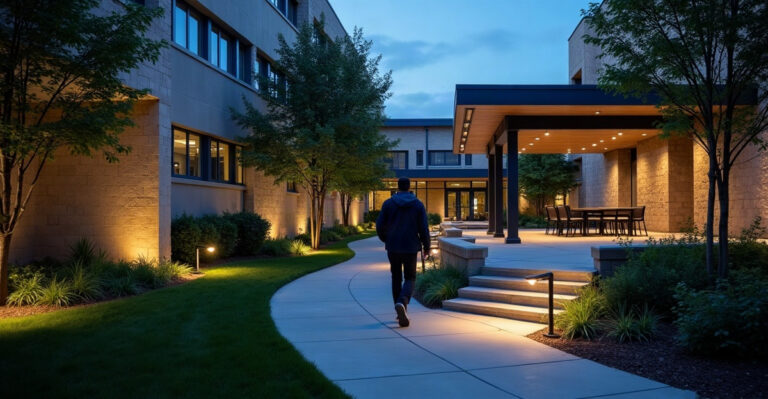
Pathways and landscapes guide movement. Steps, ramps, and changes in direction should remain clearly visible. Shielded fixtures reduce glare and prevent light spill into adjacent areas. A well-planned layout mirrors techniques used to layer outdoor lighting like a pro, where visibility and aesthetics work together.
Parking lot illumination focuses on uniformity. Avoid uneven patches of brightness and shadow. Pole height, spacing, and beam distribution determine full coverage. Motion sensors can reduce output during low-traffic hours while maintaining baseline security.
Signage lighting ensures business names and wayfinding elements stay readable after dark. Coordinating colour temperature and brightness with facade lighting creates a cohesive identity. For branded elements and monument signs, considerations discussed in commercial sign lighting can help align visibility and design standards.
Design Principles That Balance Aesthetics, Performance, and Compliance
Good commercial building lighting balances visual appeal with measurable performance. We reference established lighting standards and dark-sky principles while keeping explanations simple.
- Lumens measure brightness output. Higher lumens mean more visible light.
- Colour temperature, measured in Kelvin, influences mood and clarity. Neutral white ranges often perform well in office environments, delivering crisp visibility without feeling harsh.
- Uniformity reduces glare and extreme contrast. Balanced light levels across a parking lot or facade improve comfort and safety.
Fixture placement affects long-term success. Avoid installing lights directly at eye level. Use shielded or full cut-off fixtures to direct light downward. This approach limits glare and supports compliance objectives.
Scalability should guide early design decisions. Office campuses and multi-tenant properties frequently expand. Electrical infrastructure, pole placement, and zoning plans should allow growth without requiring a full redesign.
Accessibility and safety regulations also play a role. Illuminated paths must accommodate all users, including those using ramps and mobility aids. Proper planning ensures that office exterior lighting supports compliance while maintaining a clean architectural aesthetic.
For teams evaluating professional upgrades, structured commercial outdoor lighting solutions provide the foundation for long-term consistency across large properties.
Energy Efficiency Strategies That Reduce Long-Term Costs
LED technology now serves as the baseline for modern office exterior lighting. LEDs consume significantly less energy than legacy systems and offer longer operational lifespans. That means fewer replacements and lower maintenance demands.
We approach projects with lifecycle thinking. Upfront costs matter, but total cost of ownership drives long-term returns. Reduced energy consumption combined with fewer service interruptions adds measurable financial value.
Practical tools increase efficiency:
- Photocells enable automatic dusk-to-dawn operation.
- Motion sensors reduce output in low-traffic zones.
- Zoning controls allow independent management of parking lots, facades, and signage.
Maintenance planning protects that investment. Commercial-grade fixtures must withstand outdoor exposure, temperature swings, and dust. Installations should allow safe access for servicing across larger properties.
Energy improvements support sustainability goals while stabilising operating expenses. Facility managers gain predictable performance instead of ongoing repair cycles tied to outdated lighting infrastructure.
For multi-location businesses, approaches similar to those outlined in permanent lighting for small businesses can scale effectively across office portfolios with the right infrastructure planning.
Smart Lighting Controls: A Scalable Upgrade for Modern Office Buildings
Smart lighting enhances commercial building lighting without requiring a complete system overhaul. We treat it as a flexible upgrade that builds on solid fixture design.
Scheduling automatically adjusts lighting based on business hours. Remote dashboards allow facility managers to monitor performance from one central platform. Integration with building management systems supports broader operational control.
Performance tracking and energy monitoring provide actionable data. Property owners can measure usage trends and optimise output settings for different zones.
The benefits are practical:
- Lighting levels can decrease after hours without manual adjustments.
- Automated responses can increase brightness if motion is detected in restricted zones.
- Maintenance alerts reduce downtime by identifying fixture or power issues early.
Smart solutions strengthen office curb appeal while improving financial performance. Adjusted light scenes support special events, seasonal branding, or multi-tenant requirements without physical rewiring.
Businesses evaluating scalable upgrades often explore whether permanent lighting can be used for businesses. Smart-enabled systems typically integrate seamlessly into those strategies.
Planning a Retrofit or New Build: Key Considerations Before You Start
Every successful project begins with assessment. Older fixtures, uneven illumination, glare complaints, or high maintenance costs signal the need for evaluation.
Large properties benefit from a professional lighting audit. Detailed measurements reveal inconsistencies that may not be visible during daytime walkthroughs. Phased upgrades help manage budget constraints while improving priority zones first.
Common planning questions include:
- What affects the cost of office exterior lighting? Fixture type, pole infrastructure, control systems, and installation complexity all influence total investment.
- Can older buildings be retrofitted with LED and smart controls? In many cases, yes. Existing infrastructure often supports upgrades without full rewiring, depending on condition.
- How quickly can energy-efficient upgrades deliver ROI? Timelines vary by usage and property size, but energy and maintenance savings contribute steadily to long-term cost reduction.
We recommend prioritising safety-critical zones first. Focus on entries, walkways, and parking areas. Then expand into facade accents and branding enhancements.
Well-planned office exterior lighting improves safety, supports compliance, increases efficiency, and strengthens long-term property value. For organisations ready to move forward, we coordinate evaluations and design planning through our lighting consultation team to align performance, aesthetics, and operational goals from day one.