Residential Lighting Controls for Outdoor Smart Lights
Residential lighting controls for outdoor smart lights should match each area’s purpose, power source, weather exposure, and automation needs. We use photocells, motion sensors, timers, smart switches, relays, and landscape controllers to keep entries, driveways, patios, paths, gardens, and seasonal displays reliably lit.
Key Takeaways
- We use photocells for dusk-to-dawn lighting, motion sensors for driveways and side paths, and timers for decorative or seasonal fixtures.
- We match controls to the existing system. Mains-voltage circuits, low-voltage landscape systems, plug-in lights, and battery-powered accessories need different equipment.
- We confirm compatibility between LED bulbs, fixtures, drivers, transformers, relays, and dimmers. This prevents flickering, humming, and unreliable dimming.
- We choose outdoor-rated devices, enclosures, wiring connections, and junction boxes for the site’s rain, dust, and temperature exposure.
- We plan local manual controls alongside apps and automations. Essential outdoor lighting then remains available during connectivity or system failures.
Choose the Right Outdoor Control for Each Area
Residential lighting controls make outdoor spaces easier to use after dark. They support convenience, ambience, energy-conscious operation, visibility, and security support without requiring every light to run at full output all night.
Reduced runtime can lower energy use, although actual savings depend on fixture wattage, operating hours, schedules, daylight, sensor behaviour, and whether the system already uses LEDs. We also treat lighting as one part of a broader property-security plan. Well-planned lighting can improve visibility, reduce dark concealment areas, and create a lived-in appearance, but it cannot replace locks, cameras, alarms, or other security measures.
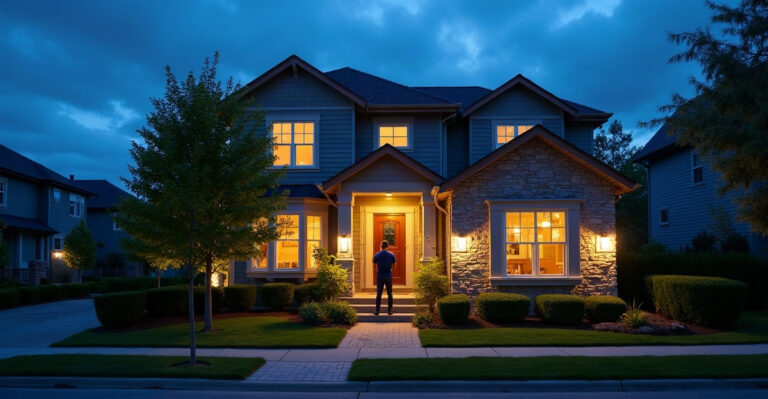
At the front entry and porch, photocells or a dusk-to-dawn sensor provide dependable after-dark illumination. Adding smart switches or relays gives us schedules, remote control, scenes, and conventional wall-switch operation where the system supports it. Our residential outdoor lighting approach can combine these controls into a clean, practical entry sequence.
Driveways and garages work well with an outdoor motion sensor for arrival lighting, plus scheduled lighting for established evening routines. Side paths, bin areas, and service routes also benefit from motion activation. Set the detection zone, sensitivity, mounting height, and timeout carefully, especially where pets, passing vehicles, or nearby foot traffic could trigger lights unnecessarily.
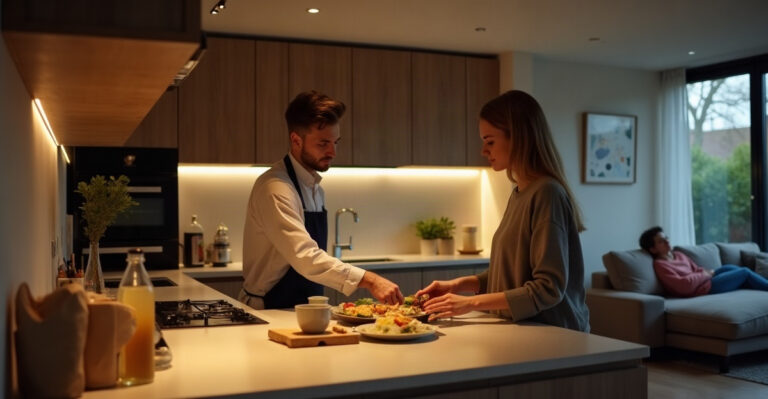
Patios, decks, and outdoor kitchens need flexible control. Compatible dimmers, smart switches, relays, and scenes can shift lighting from bright food preparation to relaxed dining or entertaining. For these spaces, outdoor mood lighting gives us useful layers of light rather than a single harsh setting.
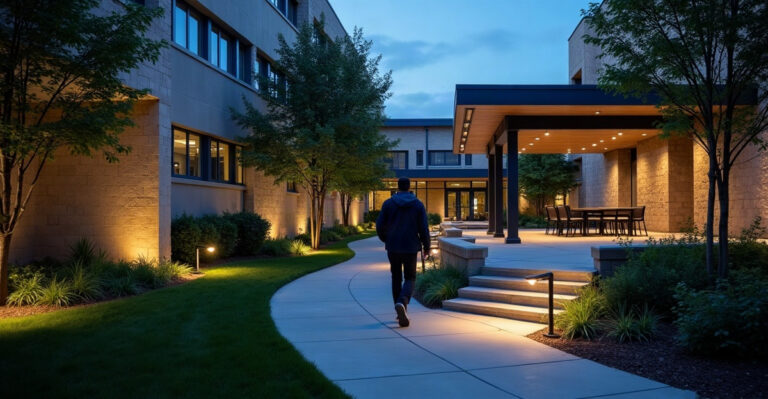
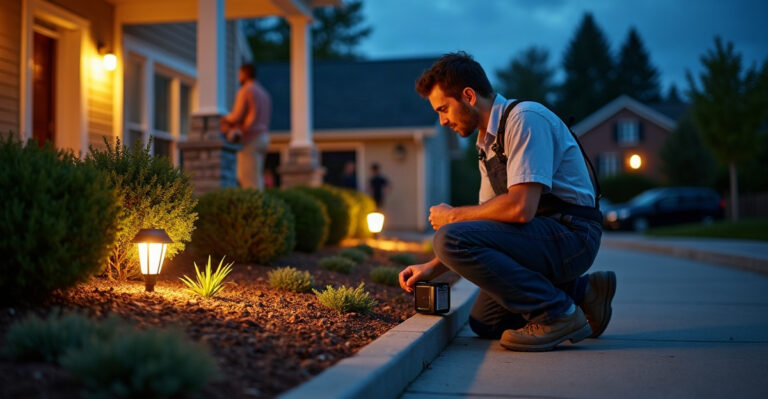
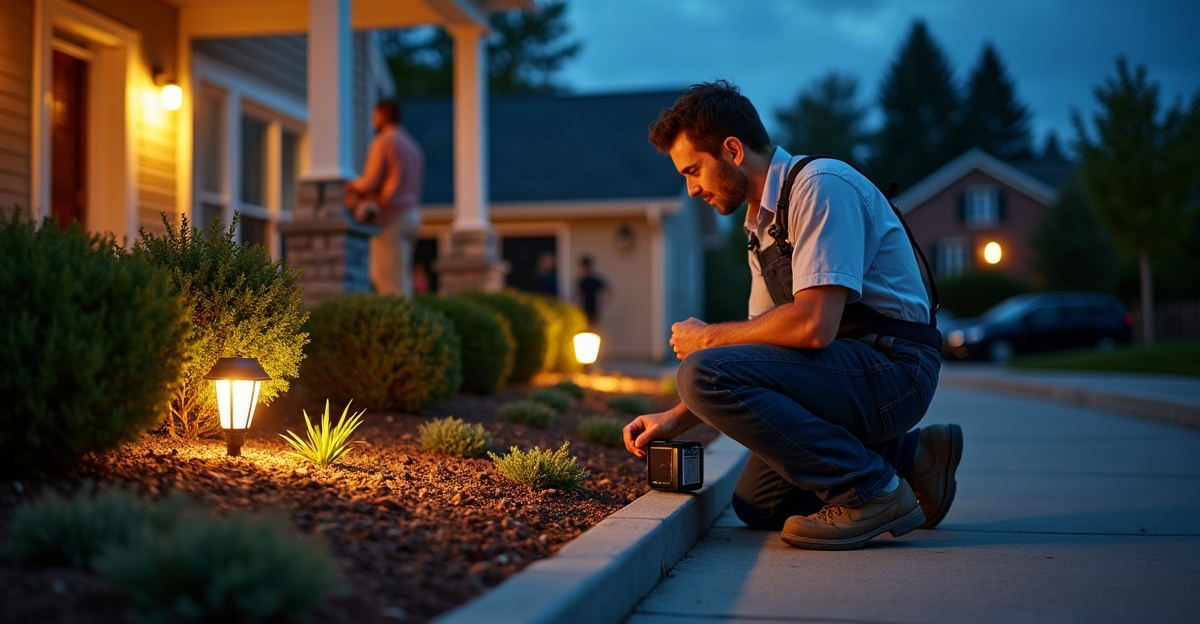
Garden and landscape features usually need a low-voltage landscape lighting controller matched to the transformer-based system. A photocell, timer, or app schedule can then operate path lights, trees, feature planting, and accent fixtures consistently. Pool and water-adjacent lighting may have specialised safety requirements, so professional design is essential.
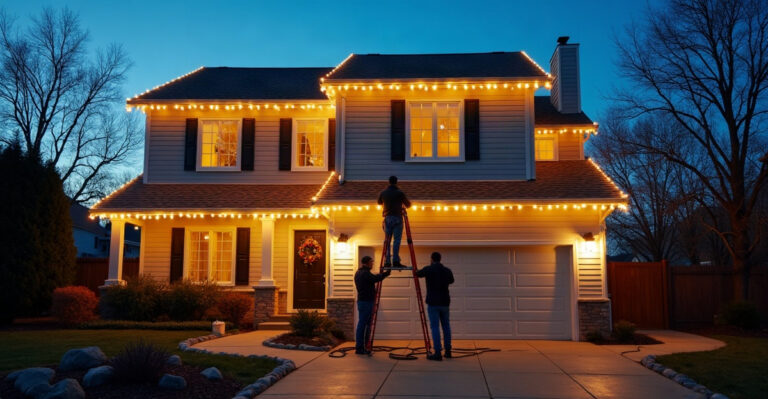
For seasonal displays and decorative fixtures, an outdoor light timer, astronomical timer, or suitably rated outdoor smart plug can provide straightforward outdoor lighting automation. We can also use outdoor holiday lights with schedules that prevent lights from operating long after everyone has gone to bed.
Outdoor Lighting Controls Compared: What Each Option Does Best
Outdoor lighting controls for residential systems can use simple automatic devices, connected smart products, or a combination of both. The right option depends on the lighting circuit, location, desired control, and available connectivity.
| Control type | Best outdoor applications | Automation capability | Installation complexity | Connectivity requirement | Key compatibility concern | Manual fallback option |
|---|---|---|---|---|---|---|
| Photocell outdoor lights | Entrances, façades, address lights, landscape lighting | Turns lights on at dusk and off at dawn | Low to moderate | None | Nearby lighting can affect sensor readings if placement is poor | Wall switch or local override, where fitted |
| Timer or astronomical timer | Decorative lights, seasonal displays, landscape accents | Fixed times or sunrise/sunset schedules | Low to moderate | None for basic timers | Correct programming and suitable load rating | Local timer override or switch |
| Motion sensor | Driveways, garages, side paths, bin areas | Activates lighting on detected movement | Moderate | None | Sensitivity, detection angle, pets, mounting height, timeout | Local override, where supported |
| Dimmer | Patios, decks, entertaining and architectural lighting | Brightness adjustment and scenes with smart models | Moderate | Varies by model | Fixture, bulb, driver, and dimmer must all be compatible | Wall dimmer control |
| Outdoor smart switch or smart relay | Hardwired lighting circuits and multi-zone control | Schedules, remote control, scenes, integration | Moderate to high | Usually Wi-Fi, hub, or smart-home network | Neutral wiring, load type, enclosure space, local code | Conventional wall control where supported |
| Outdoor smart plug | Plug-in decorative and temporary lights | Schedules, remote control, basic scenes | Low | Usually Wi-Fi or Bluetooth | Plug, outlet, and connected load need outdoor suitability | Plug button or outlet control |
| Smart bulb | Individual brightness or colour control | Schedules, colour changes, scenes | Low | Varies by product | Needs continuous power; avoid incompatible dimmer circuits | App or local switch, depending on setup |
| Low-voltage landscape lighting controller | Transformer-based garden and path lighting | Photocell, timer, schedule, and app options | Moderate | Varies by controller | Must match the low-voltage transformer system | Controller button or transformer control |
| Whole-home automation system | Custom builds, renovations, and multi-zone properties | Unified scenes, sensors, keypads, and integrations | High | Hub, network, or wired control system | Planning, programming, and ecosystem compatibility | Keypads, local switches, or controller access |
A fixed outdoor light timer follows programmed clock times. An astronomical timer adjusts operation around local sunrise and sunset, which makes it particularly useful as seasonal daylight changes. For more guidance, see our outdoor lighting timer guide and seasonal lighting schedules.
Photocells work best when they can read natural daylight accurately. Poor placement near a porch fixture may cause false switching, cycling, or delayed activation. Motion sensors need the same care. A well-aimed detector should cover the intended route without reacting to every passing animal or vehicle.
Start With Your Existing Lighting System and Power Type
Before selecting outdoor smart lights, we identify the power type. Mains-powered outdoor lighting, low-voltage landscape lighting, plug-in fixtures, and battery-powered accessories require different controls and installation methods.
Line-voltage outdoor lighting controls generally manage fixed 120V or 230V circuits, depending on the local electrical system. Hardwired smart switches and smart relays are commonly used for these circuits. They can control groups of fixtures, provide schedules and scenes, and retain standard wall control where the device and wiring arrangement allow it.
Low-voltage landscape lighting uses a transformer to power garden and path fixtures. A low-voltage landscape lighting controller is made for this transformer-based arrangement. It cannot be replaced with a mains-voltage switch control. Mixing these systems creates compatibility and safety concerns.
Plug-in outdoor lighting controls suit compatible lamps, decorative strings, and temporary lighting. An outdoor smart plug must be appropriately rated for the location, connected load, and outlet protection. Battery-powered sensors and accessories can simplify certain installations, but they still need suitable weather ratings and dependable battery maintenance.
LED dimming compatibility deserves close attention. An LED bulb, fixture, electronic transformer, driver, relay, and dimmer may not all work together. Mismatched products can flicker, hum, fail to dim smoothly, or offer only a narrow dimming range. We recommend confirming compatibility before purchase, especially for integrated LED fixtures.
Smart bulb compatibility follows a separate rule: smart bulbs normally need continuous power to stay connected. They should not be installed on incompatible traditional dimmer circuits. In many fixed outdoor applications, an outdoor smart switch or relay is the better choice because it controls the circuit without interrupting the smart bulb’s connection.
Weather Ratings, Electrical Safety, and Installation Boundaries
A smart device is not automatically suitable for outdoor installation. Every control, enclosure, junction box, wiring connection, and power supply needs ratings appropriate for its exact exposure to rain, dust, temperature changes, and direct weather.
An ingress protection rating indicates how well equipment resists solid particles and water. Higher protection may be needed for controls exposed to driving rain, while a covered porch may allow a different rating. We still need to assess the full installation, not simply the device label. Weatherproof outdoor lighting controls also require suitable cable entries, sealed connections, and properly selected outdoor junction boxes.
Local electrical codes vary by region. We recommend checking all applicable requirements before an outdoor lighting control installation begins. Plug-in and battery-powered products can be suitable for capable homeowners when used as instructed. Hardwired lighting controls, new circuits, panel work, mains-voltage connections, outdoor electrical connections, and outdoor junction box work should be assessed and completed by a qualified electrician where required.
Failure planning matters as much as everyday operation. Confirm whether lights can still operate from a wall switch, controller, keypad, or local button if the app, internet connection, hub, or automated routine stops working. A reliable manual fallback keeps essential entry, pathway, and security-support lighting available.
Connectivity, Smart-Home Integration, and Reliable Everyday Operation
Automated controls and connected controls are different. Timers, photocells, and motion sensors can automate lighting without an app or internet connection. Outdoor smart lighting controls add remote access, notifications, scenes, and smart-home integration.
Wi-Fi outdoor lighting is familiar and convenient, but signal strength can drop through masonry, metal cladding, dense landscaping, and distance. A garden-boundary fixture may work inconsistently if it sits beyond reliable Wi-Fi coverage. Bluetooth can suit nearby control, while Zigbee outdoor lighting and Z-Wave outdoor lighting often use hub-based mesh networks that may offer stronger coverage across larger properties when planned properly.
Matter smart lighting can improve compatibility between supported smart-home platforms, although features and local control behaviour still vary by product. Some systems need internet access for remote control but can continue basic local automations during an outage. Others depend more heavily on a hub or cloud service. We verify this before installation.
Zoning makes smart outdoor lighting practical. We can separate entry, driveway, patio, side path, garden, and roofline lighting instead of controlling everything together. Scenes then make daily use simple: an arrival scene can illuminate the entry and driveway, an entertaining scene can dim patio lighting, a late-night scene can retain low pathway light, and a landscape scene can highlight planting and architectural details. Explore additional outdoor lighting automation ideas for useful scene planning.
For permanent installations, we also recommend reviewing permanent outdoor lighting controls, including the value of local operation alongside app-based features.
A Practical Checklist Before Choosing Residential Lighting Controls
Confirm the essentials before purchase
We use this checklist to choose residential lighting controls that will work reliably from day one:
- Identify whether the system is mains voltage, low voltage, plug-in, or battery-powered.
- Confirm that the fixture, bulb, transformer, driver, relay, and dimmer are control-compatible.
- Check whether the location needs weatherproof equipment, protected connections, or an enclosure.
- Decide whether the area needs dusk-to-dawn operation, motion activation, timed schedules, remote control, scenes, or a combination.
- Test Wi-Fi coverage at the exact control location, or plan for Zigbee, Z-Wave, Matter, or a suitable proprietary hub.
- Verify local operation and power-restoration behaviour if the internet, app, hub, or routine fails.
- Determine whether the work is suitable for DIY installation or requires a qualified electrician.
We recommend using photocells for dependable dusk-to-dawn operation, motion sensors for side paths and service access, timers for decorative lighting, and scene-based smart controls for patios and entertaining areas. Voice control can also complement local switches and schedules; our voice-controlled outdoor lighting guide explains where it fits best.
For a renovation, landscape upgrade, or new build, Big Pig Smart Lighting can help us review outdoor zones, existing wiring, desired scenes, and the preferred smart-home ecosystem. Contact us for a smart lighting consultation and a clear plan for dependable outdoor smart lighting design.