High End Residential Lighting Ideas for Modern Homes
We combine layered ambient, task, and accent lighting with glare control, accurate colour rendering, and intuitive dimming. This approach supports daily routines and relaxed evenings. Modern homes benefit from room-specific scenes, discreet architectural details, and early coordination of fixtures, controls, wiring, and smart-home systems.
Key Takeaways
- We layer ambient, task, and accent lighting to create practical, comfortable spaces with visual depth.
- We use smart scenes, including Cooking, Dining, Relax, Movie Night, and Night Pathway, to simplify routines and improve comfort.
- We prioritise glare control, suitable beam angles, consistent colour temperature, and reliable dimming for a refined finish.
- We match lighting to each room’s activities, from shadow-free kitchen worktops and even bathroom mirror lighting to flexible living-room zones.
- We plan lighting before construction closes up. This lets us coordinate circuits, controls, joinery, ceiling details, fixture compatibility, and future flexibility.
The Elements That Make Lighting Feel Truly High End
Premium lighting design is a complete system, not a collection of expensive fittings. We combine light quality, placement, controls, architectural detail, and decorative fixtures to create high-end residential lighting that feels effortless every day.
Luxury home lighting starts with three connected layers. Ambient lighting provides the overall illumination that makes a room comfortable to occupy. Task lighting supports specific activities, such as food preparation, reading, grooming, or desk work. Accent lighting adds definition by drawing attention to artwork, textured finishes, joinery, and architectural forms.
Layered lighting allows a space to work hard during the day and feel calm after dark. Bright, even illumination can support practical tasks, while lower levels and selective highlights create depth, warmth, and atmosphere for relaxing or entertaining.
Visual comfort matters as much as appearance. We plan glare control carefully, particularly around glossy surfaces, screens, mirrors, and seating areas. Beam angles must suit the object or area being lit, while downlights need thoughtful spacing to prevent harsh pools of light and unwanted shadows. Strong colour rendering helps finishes, food, artwork, and furnishings appear accurate and rich. Smooth dimming performance and a consistent colour temperature across connected spaces complete the refined result.
Decorative pendants and premium brands can add character, but they should support the lighting scheme rather than carry it alone. A beautiful fitting can become ineffective if it creates glare, leaves a worktop in shadow, or lacks the right control strategy.
Smart Lighting Scenes That Improve Everyday Living
Smart lighting control should make daily routines simpler. We focus on useful outcomes: quick scene changes, easy nighttime movement, energy-aware operation, security support, and lighting that adapts as the household’s needs change.
A well-planned lighting scene adjusts several sources together. Instead of operating every fitting separately, one command can set brightness, colour temperature, and selected feature lighting for the moment. An Entertain scene may brighten circulation areas while softly highlighting artwork and shelving. Relax can lower ambient lighting, warm the atmosphere, and leave a few carefully placed accents active. Cooking can provide clear worktop light, while Dining focuses attention on the table and reduces surrounding brightness.
Other valuable home automation lighting scenes include Movie Night, Wake Up, Bedtime, Away, and Night Pathway. A Night Pathway scene can activate low-level hallway, stair, bathroom, or toe-kick lighting without disturbing sleep. An Away scene can create a lived-in appearance while supporting a wider home security plan.
Wall keypads, dimmers, mobile apps, voice control, and scheduled automation can all play a role. Physical controls should remain simple, clearly labelled, and convenient for guests as well as everyday use. Smart home lighting works best when nobody needs instructions to turn on the right lights.
Energy-efficient lighting depends on several factors. Fixture selection, control strategy, occupancy, available daylight, and household behaviour all affect results. Dimmable lighting and automated lighting can reduce unnecessary operation, but the system must reflect how each room is actually used.
Lighting Ideas for Every Room and Lifestyle Moment
Every room needs a different response. We match kitchen lighting ideas, living room lighting design, and private-space lighting to the activities, mood, and visual priorities of each area.
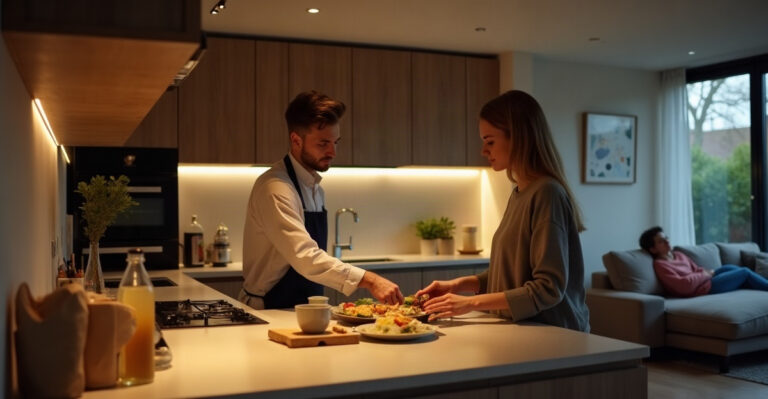
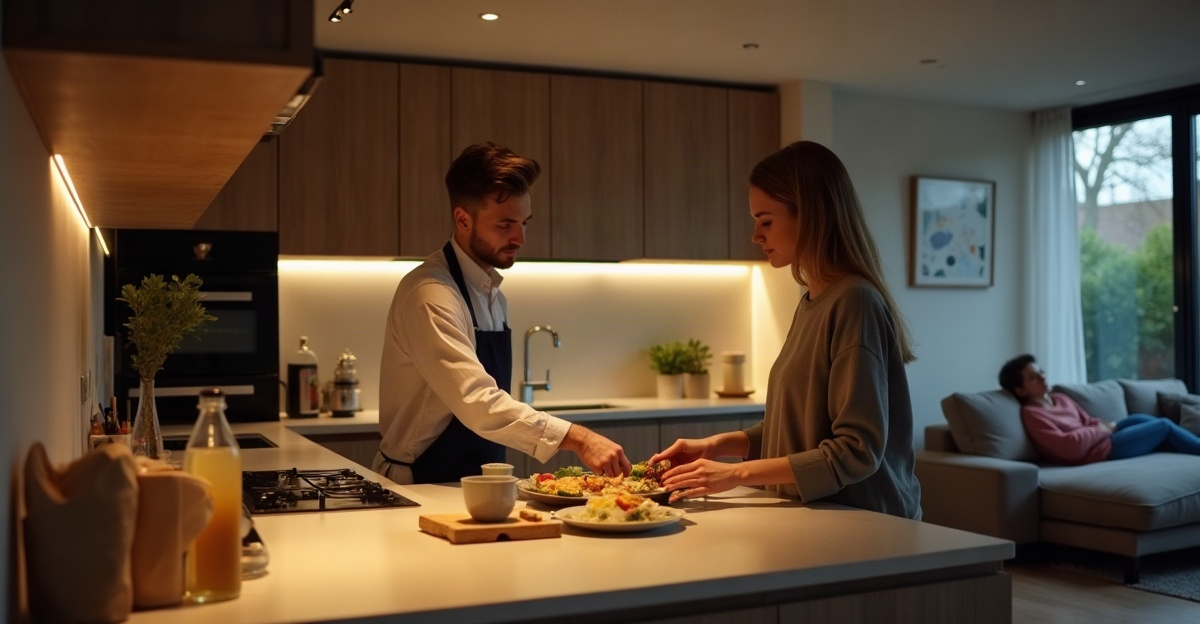
In kitchens, shadow-free task lighting over worktops comes first. Under-cabinet lighting helps eliminate shadows created by upper cabinets, while dimmable ceiling lighting provides general visibility. Island pendants can define the social centre of the room, provided they do not block sightlines or create glare. Low-level evening lighting lets the kitchen remain useful without feeling clinical.
Living rooms benefit from flexibility. Concealed LED lighting, table lamps, floor lamps, directional downlights, wall washing, and accent lighting can create zones for reading, conversation, television, and entertaining. We avoid relying on a grid of bright downlights alone, as this often makes a living area feel flat.
Dining spaces need a focal point with control. A pendant or chandelier should illuminate the table rather than overpower the room. Dimmable ambient lighting and subtle accent lighting give the setting presence while keeping the table comfortable for meals and conversation.
Bedroom lighting should support rest as well as practical routines. Layered bedside reading lights prevent disturbance, soft ambient light reduces harsh contrast, and wardrobe lighting improves visibility. Low-level night navigation can guide movement without a bright ceiling light.
Bathroom lighting design requires bright, even mirror lighting for grooming. We use suitable IP-rated fittings where required, then add dimmable ambient lighting and softer evening scenes to make the room feel less functional at the end of the day.
Hallways, staircases, and entrances set the tone on arrival. Discreet guidance lighting, wall lights, feature pendants, and automated scenes create a welcoming first impression and safer movement after dark. Home office lighting should provide comfortable task light, reduce screen glare, and adapt for focused work or video calls.
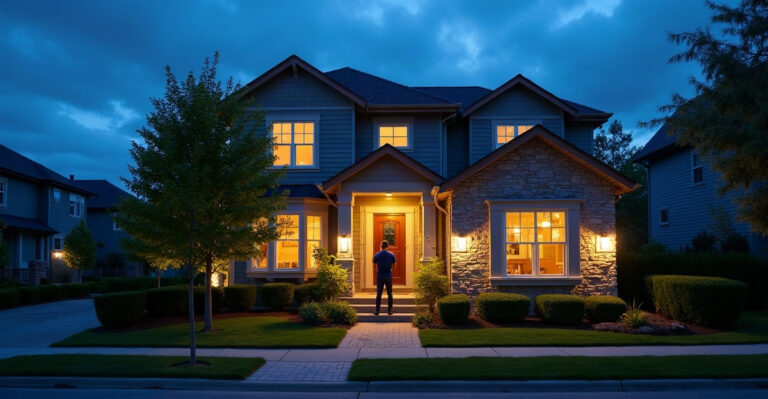
Outdoor lighting, artwork lighting, and feature wall lighting deserve the same restraint as interior spaces. Controlled accent lighting can reveal planting, façades, pathways, sculptures, artwork, textured surfaces, and joinery without excessive brightness or light spill. For more ideas, explore our outdoor lighting layers and architectural lighting ideas. Our outdoor accent lighting service helps create clear focal points after sunset.
Architectural Details and Fixtures That Create a Refined Finish
Architectural lighting gives a modern home depth without filling every ceiling with visible fittings. Concealed lighting is especially effective where the architecture deserves attention. Recessed LED channels, cove lighting, illuminated shelving, joinery lighting, under-stair lighting, toe-kick lighting, and curtain-pocket lighting can create an elevated finish while keeping the light source discreet.
Wall washing spreads light broadly and evenly across a surface, helping rooms feel larger and brighter. Wall grazing places light close to textured materials, revealing stone, timber, brick, plaster, or feature panels through shadow and contrast. Both techniques add dimension to plain surfaces, but their effect depends on fixture position and material finish.
Beam angle selection is essential. Narrow beams suit focused artwork, sculptures, and architectural highlights. Wider beams work better for broad illumination and general coverage. Recessed lighting must be spaced carefully to create an even result without scallops, dark gaps, or overlapping glare.
Statement lighting works best where it has a clear purpose. A chandelier above a dining table, a sculptural pendant in a stairwell, or a feature fixture in an entrance can anchor the composition. We select statement lighting after resolving ambient lighting, task lighting, and accent lighting, so appearance never compromises function.
Warmer colour temperature generally supports relaxed residential spaces. Task-focused areas can use clearer light where appropriate. Maintaining consistent colour temperature across open-plan and connected areas helps the home feel visually coherent. For a restrained look, see our minimalist outdoor lighting guide.
Plan the Lighting Design Before Construction Closes Up
Early lighting planning reduces uncertainty, avoids costly late changes, and produces a cleaner integrated result. During a renovation or new-build lighting design process, lighting circuits, wiring routes, control locations, ceiling voids, joinery details, shading, and system integration often need decisions before walls and ceilings close.
We recommend coordination between homeowners, architects, interior designers, electricians, and lighting specialists from the first design stages. A residential lighting plan should consider room layouts and furniture positions, activities in every zone, daylight availability, ceiling heights, feature surfaces, lighting layers, fixture locations, control positions, dimming requirements, joinery and ceiling details, outdoor lighting, and future flexibility.
Not every property needs a full-home automation system. Some homes benefit most from well-planned dimming in key rooms and simple scene controls. Others call for an integrated whole-home platform that coordinates lighting controls, shades, sensors, and wider smart-home functions. The right approach should fit the scale of the home, the lifestyle of the household, and the desired level of control.
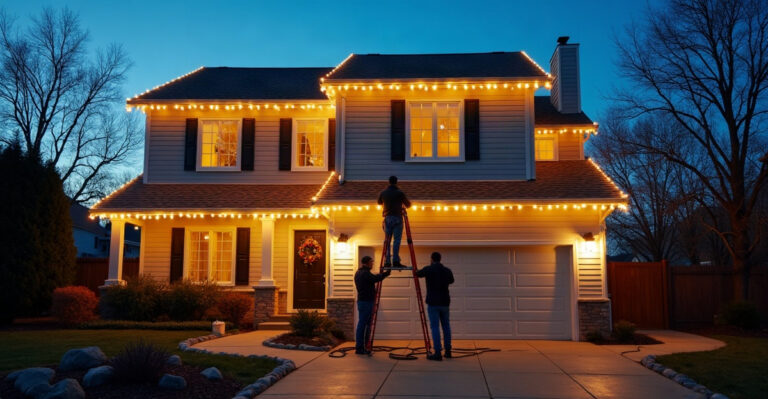
For exterior projects, our residential outdoor lighting service can coordinate pathways, façades, planting, and entertaining areas as part of the wider plan. Permanent installations may also benefit from permanent roofline lighting that complements the home’s architecture year-round.
Choosing a System That Will Work Beautifully Over Time
Compatibility is not universal across a residential smart lighting system. Integration depends on the lighting-control platform, existing infrastructure, fixture drivers, protocols, and other connected systems. We verify lighting compatibility between dimmers, LED drivers, fixtures, shades, sensors, switches, and any wider smart-home platform during planning rather than after installation.
Quality also affects how the system performs over time. Prioritise reliable dimming, consistent colour appearance, serviceable components, appropriate fixture ratings, and professional installation. LED driver compatibility is particularly important, as poor matching can cause flicker, limited dimming range, unstable performance, or premature component failure.
Future-proof lighting does not mean chasing every short-lived trend. It means choosing flexible layers, quality light sources, discreet detailing, intuitive controls, and scenes that can evolve as routines change. A modern home lighting scheme should still feel comfortable and useful years after installation.
Homeowners planning a renovation or new build can arrange a professional lighting consultation with us. We can define priorities, coordinate technical requirements, and create a lighting scheme that suits the architecture, lifestyle, and long-term goals of the home.